Original article from Antique Collecting (March 1979), pp. 22–24. Also includes pp. 17–21 with advertisements and "Where to buy clocks" clock shop directory.
Early European clockmaking. A very finely preserved south German painted iron chamber clock of c.1620, quarter striking and with alarm.
A seventeenth-century chamber clock. [This is a detailed, four-page description, signed by Beresford Hutchinson on 21 October 1977].
With autographs of event attendees.
Original article from The Connoisseur, vol. 96 no. 472 (December 1935), pp. 312–314.
Original article from World of Antiques: Collectors' Guide (1969), pp. 92–95.
Original article from The Antique Dealer and Collectors' Guide (December 1949), pp. 20–22.
Original article from Nature (31 March 1956), pp. 600–602.
Also includes correspondence.
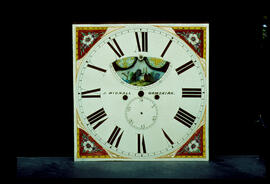
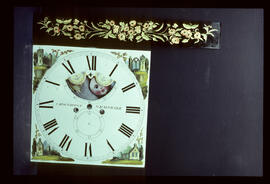
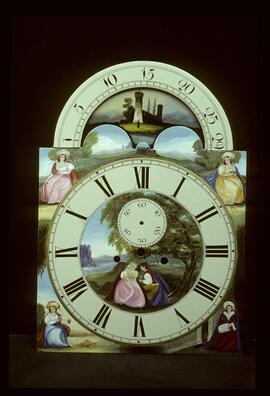
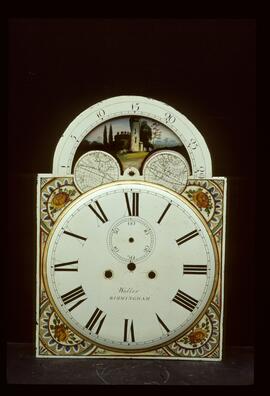
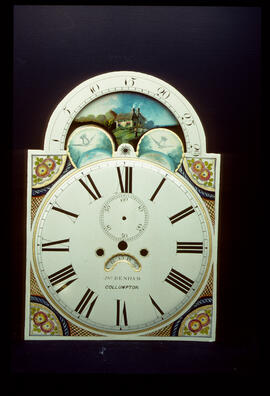
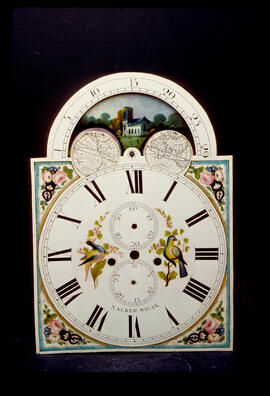
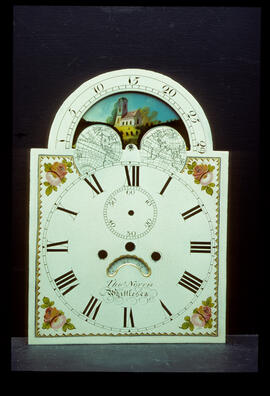
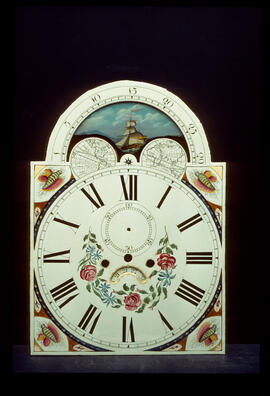
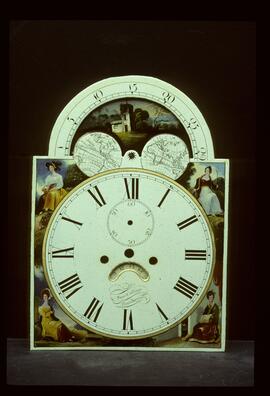
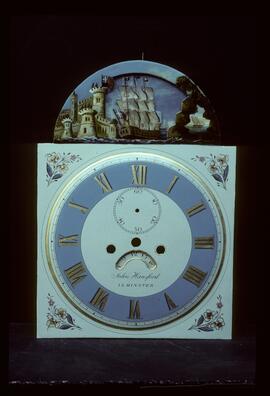
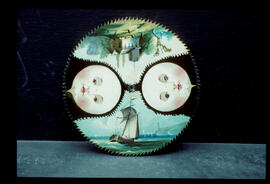
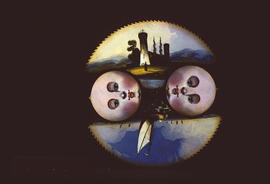
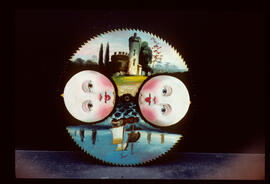
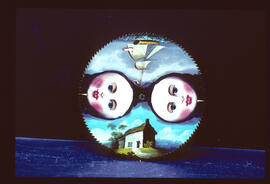
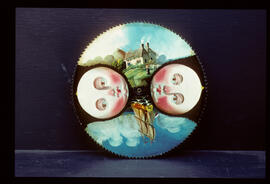
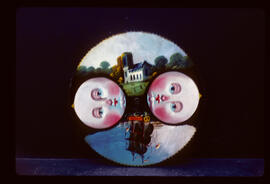
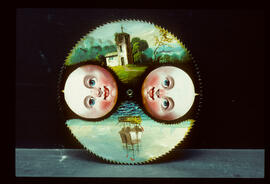
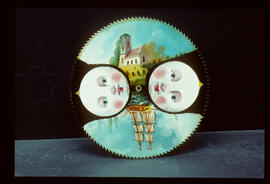
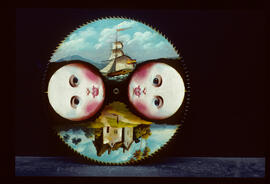
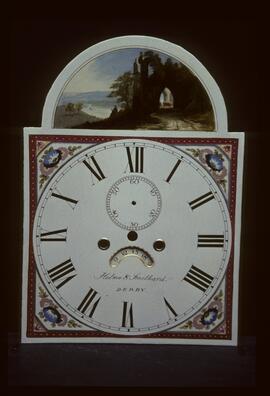
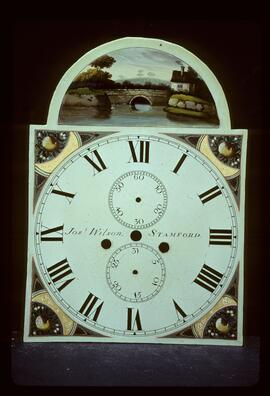
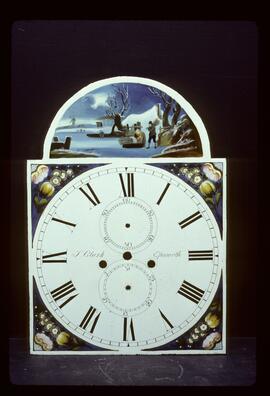
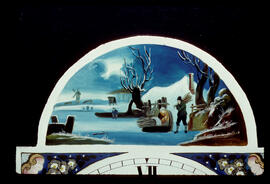
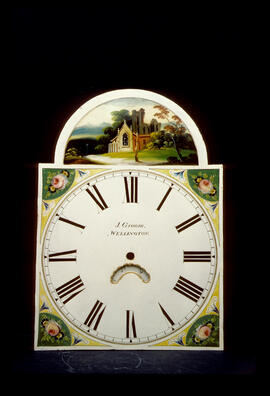
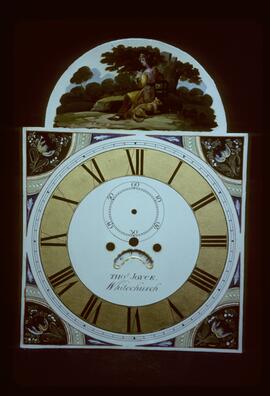
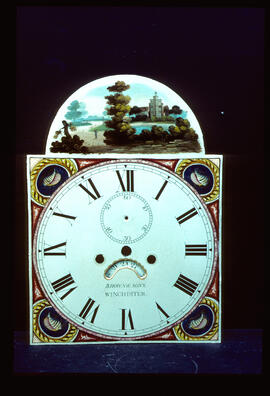
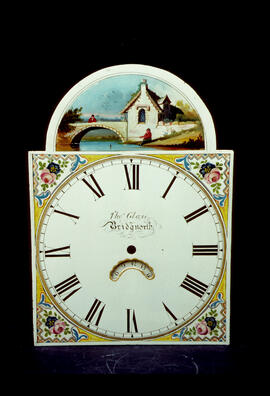
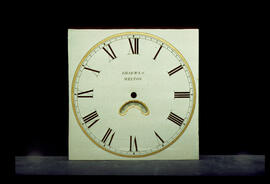
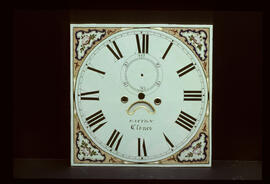
Images of dials made by Christopher Wright, a Birmingham dial maker active in the 1830s–1840s.
Main dial: pink background and roses, solid ends.
Main dial: ruins in corners, doves with gold edge in humps.
Main dial: yellow rose inside geomeric corners; gold and green.
Main dial: dished dial, auriculas in plaid surround.
Main dial: 8-day breakarch moon, pink seven blue morning glories in frame, dotted.
Main dial: small dial; roses and pink morning glories; L-shaped gold frame.
Main dial: 8-day arched moon, shells in corners, large falling roses centre.
Main dial: brightly coloured four-seasons ladies, long necks, oval faces.
Main dial: blue chapter ring, gold romans; simple flowers corners; good breakarch painting. Whole square part of dial overpainted.
Moon faces: very red cheeks, red nose, bit pensive. Moon scenes: cottage slanted on hill; ship at sea.
Main dial: green background; fruit corners; nice scene with bridge and cottage breakarch. Good painting.
Main dial: blue background to corners with pink shells, auriculas and upside down tulip corners; beautifully painted winter scene in breakarch.
Main dial: green background to roses in corners; religious ruin in breakarch.
Main dial: dark green corners with flowers; woman with dove in breakarch. Carelessy done.
Main dial: shells in dark blue ovals, rope-effect surround, red ends; fantastic scene with Palace and Tramp breakarch. Well painted.
Main dial: yellow background with pink roses and blue swirl; river in breakarch. Well painted.
Main dial: gold band, no decoration at all.
Main dial: scrolly corners, navy blue with morning glories; funny dotted background; gold ends.
Original article from Chambers's Information for the People (1860), pp. 273–288.
Some, but not all images are also included in BRO/A/15/001.
Includes letters, six photographs and a drawing.
Original article from the "Notes" section of The Connoisseur, vol. 35 no. 137 (January 1913), pp. 38–39.
Original article about 'longcases that tell you more than the time' from Art and Antiques Weekly, vol. 19 no. 9 (28 June 1975), pp. 22–25. Also includes the issue cover and editorial page with list of contents.
Photocopy of alphabetical name index, giving also year and locality, from an unknown publication. Also contains five photographs and postcards of clocks from Wiltshire and Westmorland.
Handwritten. Lectures given by Dr Ward at Chester on 28 September 1979, Cardiff in November 1979 and Leicester on 4 December 1981.
Original pages extracted from The Horological Journal (1910-26) and photocopy from The Jeweller and Metalworker (1894). Also includes notes about Watch and Clock Makers' Pension Society and the Clockmakers' Company (1910) and statistics for exports of clocks and watches in 1926.
A mahogany, banjo, clock barometer of the highest quality.
A very fine and large mahogany banjo clock barometer.
Original article about Ocborne Clocks company from Essex, from Buying Antiques, vol. 1 no. 10 (October 1973), pp. 383–384.
41 pages. Includes clocks quotations; famous clocks of the world; clocks of Berne, Switzerland; clocks of Italy; “My own town”, including Weston-super-Mare's floral clock; other floral clocks; The Festival of Britain clock; Somerset's Cathedral; Exeter's clocks; other clocks of interest; clocks of Denmark, including grandfather clocks and early clocks; clock legends of Hampton Court and Strasbourg; collectors, collections and quaint clocks; and dials ancient and modern. Pages 28 onwards comprise miscellaneous material on a variety of clock-related topics, including Gothic iron clock, long case clocks, other individual clocks, "The Old Clockmaker" article by Richard Church from Country Life (2 December 1949), and clockmaking events and exhibitions.
37 pages. Includes accidental demolition of Highbridge clock tower in a lorry crash; Weston's floral clock; "The world's first production line" article on Thomas Tompion; "Country ways of telling how time slips away" article by Kathleen Wiltshire; the Ilbert collection; the Great Clock of Prague; floral clock at Niagara Falls; "Timeless timepieces" article by Hilary Gelson, etc.
36 pages, latter half black. Includes the Wells clock; Benjamin Bowring; hymns by clockmaker James Odey; turret clocks; Stonehenge; clocks of wood, etc.
41 pages. Includes various clocks (Hampton Court, Berkeley Castle, Houses of Parliament); George Honeybone; Salisbury Cathedral clock; various clocks of Britain, Prague, Germany, Switzerland, Denmark and France; curiosities; two well-known Danish clocks; bracket clocks; long case clocks; eighteenth-century clocks; Greenwich mean time; atomic clock; Honeybone clock; miscellaneous clocks; history of Big Ben, etc.
40 pages. Includes clocks of Scotland; smallest watches; "Negress clock"; astronomical clock of Versailles; Salisbury Cathedral clock; the oldest clock in Paris; clocks of Germany, Holland, Hungary, France, Belgium, Malta, Denmark, Spain and Venice; summer time; clocks of York; Big Ben; concave dial clock at Bristol; grandfather clocks; brochure about the Peace Tower carillon in Ottawa; seventeenth-century clockmakers; Captain Scott's watch; watches in the Worshipful Company of Clockmakers collection; Strasbourg Cathedral clock; clock collection of Mr Hutton-Stott; grandfather clocks; detailed description of the Broadgate "Godiva clock" in Coventry (with original drawings); floral clocks; Lund Cathedral clock, Sweden; Honeybone clocks, etc.
41 pages. Includes royal palace clocks; clocks of Salzburg, Loches and Milan; the Christ (or the Twelve Apostles) clock at Goslar, Germany; clocks around the world (Ceylon, the USA, France, Italy, Holland, Belgium, Poland) and Britain; Michael Bateman's article on "Timing the Future"; watch exhibition at the Hague; Big Ben; Wells Cathedral clock; Timex Time through the ages brochure; tower clocks; notes on curious types of clocks (shadow clock, clock jacks, silent clock, Act of Parliament clock, water clock, sundial stained glass window); Alex Lloyd's article on collecting old clocks; Salisbury Cathedral clock; sundials; Jens Olsen's clock; clocks at the Nottingham Antiques Exhibition; clocks of Rothenburg and Nuremburg, etc.
37 pages. Includes address on "Our Ancestors' Clocks and Watches" by M.F. Frederiksen; astronomical clock on Strasburg Cathedral; "Pendulum to Atom" booklet for the centenary exhibition of the British Horological Institute at Goldsmiths' Hall; "Collecting old Watches" by Cecil Clutton; Conquete du Temps (booklet presented to visitors of the Swiss Pavilion at the Brussels Exhibition 1958); "Time in Broadcasting' (BBC Booklet produced for the centenary exhibition of the British Horological Institute); Burgos Cathedral clock, Spain; clocks of Southwark and Clerkenwell; Zimmer Tower astronomical clock at Lierre, Belgium; flower clocks; British horologists; atomic clock; clocks of Bornholm; Buenos Aires "Big Ben" clock; world's largest electric clock; work of summer time clock changers; English ormolu mounts; Black Forest cuckoo clocks; Big Ben centenary; broadcast of "Ancient clocks of the West of England"; clocks of Germany and Switzerland; Kravchenko's Sputnik Clock; English church clocks; music scores for "My Grandfather's Clock" by Henry C. Work and "Song of the Clock" by Rex Burchell; early English watches, etc.
41 pages. Includes Honeybone clock at Bristol; clock collection at Belper; "From Clock-watch to Wrist Watch" and "The Rare Grandmother Clock”, articles from Country Life Annual 1955; "Sixteenth century and earlier public clocks" list by G. H. Baillie; clocks of Denmark, Holland and Germany; clocks of Coventry and Winchester; auction sale of Tompion long case clock; "A clock to time the Earth", an article on John Harrison by Alben Philips; floral clocks; copy will of Thomas Honeybone; extract from Cats in the Belfry by Doreen Tovey; Jens Olsen's world clock brochure; Guinness Festival Clock; Westminster Abbey clock overhaul; The Musselburgh Tolboth clock; Ilbert horological collection; the world' first astronomical clock at the Science Museum; extract from The Dean's Watch by Elizabeth Goudge
37 pages. Includes candle-lighting clock; "The story of the British watch and clock industry"; Mr Vine's matchstick clock; "Clocks", an article by Sheila Richardson about clocks of Nuremburg, Prague, Strasbourg and Lund; Kienzle watch museum brochure (in German); article on Stanley Humphrey's maintenance of government clocks; the Birdcage Clock; long case clocks; Winchester Empire Clock; John E. Ginson's article on the passing of time; Big Ben; Mr and Mrs Bromley's clock collection at Belper; American clocks; new battery-driven clocks; radiation risk of luminous dials; Crucifix Clock, etc.
37 pages. Includes giant floral clock of Frankfort, Kentucky; astronomical clock at Strasbourg; article on mental clocks "So that's why women are always late..."; 30-hour Tompion clocks; water clocks; Geneva's new automatic clock; turret clock at Lockinge; 93-dial Wonder Clock at Washington Museum; Synchronome clock factory; Tompion clock in Bath Pump Room; Dover Castle clock; "Collecting Old Watches" by Cecil Clutton; Edward East, watchmaker to Charles I; sixteenth to eighteenth century table clocks; "Clocks by Thomas Tompion in American Collections"; clocks of Austria, Holland and Germany; clocks of New Zealand, etc.
37 pages. Includes short history of clocks; floral clocks; Player's Cigarettes cards featuring clocks and other timekeeping devices, with notes; types of devices used for the measurement of time (list with descriptions); "Look and Learn" feature on timekeeping; Breguet watches; Phoenix clock at Westbury; Gamle Ure brochure from the clock museum on Denmark; Chinese clockmaking industry; timing the Olympics [Winter Olympics, Innsbruck]; clock towers of France; "Early provincial clockmakers" by J.K. Bellchambers; The Science Museum Timekeepers booklet; Ferenc Magyar clock and watch collection in Budapest; clock designed for lunar explorers; The Wuppertal clock museum, etc.
These albums contain images of clocks which went through the business, together with typed "descriptive tickets", i.e. one-page detailed descriptions of the clocks and their cases, dials and movements, prices, as well as biographical notes about the makers and references to published sources. Some clock photographs are included without the descriptive tickets, and conversely, some descriptive tickets do not have accompanying photographs, which are often annotated as having been lent to various individuals or institutions.
These are loose photographs and descriptions, originally inserted in volume STR/02/017.
This volume also includes a New Year's greeting card with family photograph from "Karyn, Bill and Harrison Frist".
Folder marked "4" but it is sixth in the chronological sequence.
Vienna regulators in this file are mostly duplicates of those listed in files STR/02/001-018, although included are also some photographs of other, often unlabelled Vienna regulators.
This collection comprises Philip Thornton’s reports, notes, sketches and tracings which document the repairs and restorations of mainly bracket clocks, carried out by him primarily in the 1930s and 1940s, with a few later instances. Most papers record the date of restoration and the name of the client. The files vary in size and content from single pieces of scrap paper to more comprehensive bundles containing condition reports and detailed large-format drawings. Many of the papers are in very fragile condition.
Gives customer's name, type of clock, work carried out, price, and in a few cases date. Also includes loose notes.
These clock files, arranged by clock type, contain one-page descriptions of the clocks and their cases, dials and movements, prices, as well as biographical notes about the makers and references to published sources. They are copies of the descriptive tickets included in the photograph series STR/02, but here they are arranged by clock type and annotated with sale details (invoice number, date and price).
A small and elegant rosewood timepiece by a local maker.
An elegantly proportioned and finely figured rosewood four-glass clock.
A good, small, inlaid mahogany timepiece.
A small William IV rosewood library timepiece with engraved silvered dial and fusee movement, the case with recessed brass carrying handle and adjustable bun feet.